


/**
 * This class extends the BinarySearchTree by adding the rotate methods.
 * Rotation will change the balance of a search tree while preserving the search tree property.
 * Used as a common base class for self-balancing trees.
 *
 */
public class BinarySearchTreeWithRotate<E extends Comparable<E>> extends BinarySearchTree<E> {
	private static final long serialVersionUID = 1L;

	// Methods

	/**
	 * Method to perform a right operation.
	 * pre: root is the root of a binary search tree.
	 * post: root.right is the root of a binary search tree.
	 *       root.right.right is raised on level.
	 *       root.left.left does not change levels.
	 *       root.left is lowered one level,
	 *       the new root is returned.
	 * @param root
	 * @return
	 */
	protected Node<E> rotateRight(Node<E> root) {
		Node<E> temp = root.left;
		root.left = temp.right;
		temp.right = root;

		return temp;
	}

	protected Node<E> rotateLeft(Node<E> root) {
		Node<E> temp = root.right;
		root.right = temp.left;
		temp.left = root;

		return temp;
	}

	public static void main(String[] args) {
		BinarySearchTreeWithRotate<Integer> app = new BinarySearchTreeWithRotate<Integer>();
		BinarySearchTree<Integer> bst = new BinarySearchTree<Integer>();

		Node<Integer> root = new Node<Integer>(20);
		root.left = new Node<Integer>(10);
		root.left.right = new Node<Integer>(15);
		root.left.left = new Node<Integer>(5);
		root.left.left.right = new Node<Integer>(7);
		root.right = new Node<Integer>(40);
		bst.root = root;
		System.out.println(bst);
		bst.root = app.rotateRight(bst.root);
		System.out.println("**********************");
		System.out.println(bst);
	}
}


public class BinarySearchTree<E extends Comparable<E>> extends BinaryTree<E> implements ISearchTree<> {
	// Data fields

	private static final long serialVersionUID = 1L;

	/**
	 * Return value from the public add method.
	 */
	protected boolean addReturn;

	/**
	 * Return value from the public delete method.
	 */
	protected E deleteReturn;

	/**
	 * Starter add method pre: The object to insert must implement the
	 * Comparable interface.
	 *
	 * @param item
	 *            The Comparable object being inserted.
	 * @return true if the object is inserted, false if the object already exits
	 *         in the tree.
	 */
	public boolean add(E item) {
		root = add(root, (Comparable<E>) item);
		return addReturn;
	}

	@SuppressWarnings({ "unchecked", "rawtypes" })
	private Node<E> add(Node<E> localRoot, Comparable item) {
		if (localRoot == null) {
			// The item is not in the tree - insert it
			addReturn = true;
			return new Node(item);
		} else if (item.compareTo(localRoot.data) == 0) {
			addReturn = false;
			return localRoot;
		} else if (item.compareTo(localRoot.data) < 0) {
			// item is less than the localRoot.data
			localRoot.left = add(localRoot.left, item);
			return localRoot;
		} else {
			// item is greater than the localRoot.data
			localRoot.right = add(localRoot.right, item);
			return localRoot;
		}
	}

	@Override
	public boolean contains(E target) {
		// TODO Auto-generated method stub
		return false;
	}

	/**
	 * Starter method find. pre: The target object must implement the Comparable
	 * interface.
	 *
	 * @param target
	 *            The comparable object being sought.
	 * @return The object, if found, otherwise null
	 */
	@Override
	public E find(E target) {
		return find(root, (Comparable<E>) target);
	}

	/**
	 * Recursive find method.
	 *
	 * @param localRoot
	 *            The local subtree's root.
	 * @param target
	 *            The object being sought.
	 * @return The object if found, otherwise null
	 */
	private E find(Node<E> localRoot, Comparable<E> target) {
		if (localRoot == null) {
			return null;
		}

		// Compare the target with the data field at the root.
		int compResult = target.compareTo(localRoot.data);
		if (compResult == 0) {
			return localRoot.data;
		} else if (compResult < 0) {
			return find(localRoot.left, target);
		} else {
			return find(localRoot.right, target);
		}
	}

	/**
	 * Starter method delete pre: The object being deleted must be Comparable.
	 * post: The object is not in the tree.
	 *
	 * @param target
	 *            The object to be deleted.
	 * @return The object deleted from the tree or null if the object was not in
	 *         the tree.
	 */
	@Override
	public E delete(E target) {
		root = delete(root, target);
		return deleteReturn;
	}

	/**
	 * Recursive delete method post: The item is not in the tree; deleteReturn
	 * is equal to the deletedItem as it was stored in the tree or null if the
	 * item was not found.
	 *
	 * @param localRoot
	 *            The root of the current subtree
	 * @param item
	 *            The item to be deleted.
	 * @return The modified local root that does not contain the item.
	 */
	private Node<E> delete(Node<E> localRoot, E item) {
		if (localRoot == null) {
			// The item is not in the tree.
			deleteReturn = null;
			return localRoot;
		}

		// Search for item to delete.
		int compResult = item.compareTo(localRoot.data);
		if (compResult < 0) {
			// The item i smaller than localRoot.data
			localRoot.left = delete(localRoot.left, item);
			return localRoot;
		} else if (compResult > 0) {
			// The item i greater than localRoot.data
			localRoot.right = delete(localRoot.right, item);
			return localRoot;
		} else {
			// The item is in the local root.
			deleteReturn = localRoot.data;
			if (localRoot.left == null) {
				// If there is no left child, return right child
				// which can also be null.
				return localRoot.right;
			} else if (localRoot.right == null) {
				return localRoot.left;
			} else {
				// Node being deleted, has two children
				// Replace the data with inorder predecessor.
				if (localRoot.left.right == null) {
					// the left child has no right child.
					// Replace the data with the data in the left child.
					localRoot.data = localRoot.left.data;
					localRoot.left = localRoot.left.left;

					return localRoot;
				} else {
					// Search for the inorder predecessor (ip) and
					// replace deleted node's data with ip.
					localRoot.data = findLargestChild(localRoot.left);
					return localRoot;
				}
			}
		}
	}

	/**
	 * Find the node that is the inorder predecessor and replace it with its
	 * left child (if any) post: The inorder predecessor is removed from the
	 * tree.
	 *
	 * @param parent
	 *            The parent of possible inorder predecessor (ip)
	 * @return The data in the ip.
	 */
	private E findLargestChild(Node<E> parent) {
		// If the right child has no right child, it is the inorder predecessor.
		if (parent.right.right == null) {
			E returnValue = parent.right.data;
			parent.right = parent.right.left;
			return returnValue;
		} else {
			return findLargestChild(parent.right);
		}
	}

	@Override
	public boolean remove(E target) {
		// TODO Auto-generated method stub
		return false;
	}
}
/**
 * Implements the quicksort algorithm.
 *
 */
public class QuickSort {
	/**
	 * Sort the table using the quick sort algorithm.
	 * pre: table contains Comparable objects.
	 * post: table is sorted.
	 * @param table The array to be sorted.
	 */
	public static void sort(Comparable<Integer>[] table) {
		// Sort the whole table
		quickSort(table, 0, table.length - 1);
	}

	private static void quickSort(Comparable<Integer>[] table, int first, int last) {
		if (first < last) {	// There is data to be sorted.
			// Partition the table
			int pivIndex = partition(table, first, last);
			quickSort(table, first, pivIndex - 1);
			quickSort(table, pivIndex + 1, last);
		}
	}

	private static int partition(Comparable<Integer>[] table, int first,
			int last) {
		// Select the first item as the pivot value.
		Comparable<Integer> pivot = table[first];
		int up = first;
		int down = last;
		do {
			// Invarient:
			// All items in table[first .. up-1] <= pivot
			// All items in table[down+1 .. last] > pivot
			while (up < last && (pivot.compareTo((Integer)table[up]) >= 0) ) {
				up++;
			}
			// assert: up equals last or table[up] > pivot
			while (pivot.compareTo((Integer)table[down]) < 0) {
				down--;
			}
			//assert down equals first or table[down] <= pivot.
			if (up < down) {
				// Exchange table[up] and table[down]
				swap(table, up, down);
			}
		} while (up < down); // Repeat while up is left of down

		// Exchange table[first] and table[down] thus putting the pivot value
		// where it belongs
		swap(table, first, down);
		// return the index of the pivot value.
		return down;
	}

	private static void swap(Comparable<Integer>[] table, int up, int down) {
		Integer temp = (Integer) table[up];
		table[up] = table[down];
		table[down] = temp;
	}

	public static void main(String[] args) {
		Integer[] table = { new Integer(50), new Integer(60), new Integer(45),
				new Integer(30), new Integer(90), new Integer(20),
				new Integer(80), new Integer(15), new Integer(10) };

		System.out.println("Quick sort result: ");
		QuickSort.sort(table);
		for (Integer integer : table) {
			System.out.print(integer + "  ");
		}
	}
}
/**
 * Implementation of the heapsort algorithm
 *
 */
public class HeapSort {
	/**
	 * Sort the array using heap sort algorithm.
	 * pre: table contains Comparable items.
	 * post: table is sorted.
	 * @param table
	 *            The array to be sorted.
	 */
	public void sort(Comparable<Integer>[] table) {
		buildHeap(table);
	}

	/**
	 * buildHeap transforms the table into a heap.
	 * pre: The array contains at least one item.
	 * post: All items in the array are in heap order.
	 *
	 * @param table
	 *            The array to be transformed into a heap.
	 */
	private static void buildHeap(Comparable<Integer>[] table) {
		int n = 1;
		// Invarient: table[0..n-1] is a heap

		while (n < table.length) {
			n++; // Add a new item to the heap and reheap.
			int child = n - 1;
			int parent = (child - 1) / 2;
			while (parent >= 0
					&& table[parent].compareTo((Integer) table[child]) < 0) {
				swap(table, parent, child);
				child = parent;
				parent = (child - 1) / 2;
			}
		}
	}

	/**
	 * shrinkHeap transforms a heap into a sorted array
	 * pre: All items in the array are in heap order.
	 * post: The array is sorted.
	 *
	 * @param table
	 *            The array to be sorted.
	 */
	private static void shrinkHeap(Comparable<Integer>[] table) {
		int n = table.length;
		// Invarient: table[0..n-1] forms a heap.
		// table[n..table.length-1] is sorted.
		while (n > 0) {
			n--;
			swap(table, 0, n);
			// table[1..n-1] form a heap.
			// table[n..table.length-1] is sorted.
			int parent = 0;
			while (true) {
				int leftChild = 2 * parent + 1;
				if (leftChild >= n) {
					break; // No more children.
				}
				int rightChild = leftChild + 1;
				// Find the larger of the two children.
				int maxChild = leftChild;
				if (rightChild < n // There is a right child.
						&& table[leftChild]
								.compareTo((Integer) table[rightChild]) < 0) {
					maxChild = rightChild;
				}

				// If the parent is smaller than the larger child
				if (table[parent].compareTo((Integer) table[maxChild]) < 0) {
					// Swap the parent and child
					swap(table, parent, maxChild);
					// Continue at the child level
					parent = maxChild;
				} else {
					// Heap property is restored.
					break;
				}
			}
		}
	}

	private static void swap(Comparable<Integer>[] table, int parent, int child) {
		Comparable<Integer> temp = table[parent];
		table[parent] = table[child];
		table[child] = temp;
	}

	private static void showHeap(Comparable<Integer>[] table) {
		for (int i = 0; i < table.length; i++) {
			System.out.print(table[i] + " ");
		}
		System.out.println();
	}

	public static void main(String[] args) {
		Integer[] table = { new Integer(1), new Integer(2), new Integer(3),
				new Integer(4), new Integer(5), new Integer(6), new Integer(7),
				new Integer(8), new Integer(9), new Integer(10),
				new Integer(11), new Integer(12), new Integer(13) };
		buildHeap(table);
		showHeap(table);
		shrinkHeap(table);
		showHeap(table);
	}
}
/**
 * implements the recursive merge sort algorithm. Copies of the
 * sub tables are made, sorted, and then merged.
 *
 */
public class MergeSortRecursive {
	/**
	 * Sort the array using the merge sort algorithm. pre: table contains
	 * Comparable objects. post: table is sorted.
	 *
	 * @param table The array to be sorted.
	 */
	@SuppressWarnings("unchecked")
	public static void sort(Comparable<Integer>[] table) {
		// A table with one element is sorted already.
		if (table.length > 1) {
			// Split table into halves.
			int halfSize = table.length / 2;
			Comparable<Integer>[] leftTable = new Comparable[halfSize];
			Comparable<Integer>[] rightTable = new Comparable[table.length
					- halfSize];
			System.arraycopy(table, 0, leftTable, 0, halfSize);
			System.arraycopy(table, halfSize, rightTable, 0, table.length
					- halfSize);

			// Sort the halves.
			sort(leftTable);
			sort(rightTable);

			// Merge the halves.
			merge(table, leftTable, rightTable);
		}
	}

	/**
	 * Merge two sequences
	 * pre: leftSequence and rightSequence are sorted
	 * post: outputSequence is the merged result and is sorted.
	 *
	 * @param outputsequence The destination
	 * @param leftSequence The left input
	 * @param rightSequence The right input
	 */
	private static void merge(Comparable[] outputsequence,
			Comparable<Integer>[] leftSequence,
			Comparable<Integer>[] rightSequence) {
		int i = 0; // index into the left input sequence
		int j = 0; // index into the right input sequence
		int k = 0; // index into the output sequence

		// While not finished with either sequence
		while (i < leftSequence.length && j < rightSequence.length) {
			// find the smaller and insert it into the output sequence
			if (leftSequence[i].compareTo((Integer) rightSequence[j]) < 0) {
				outputsequence[k++] = leftSequence[i++];
			} else {
				outputsequence[k++] = rightSequence[j++];
			}
		}
		// assert: one of the sequences has more items to copy.
		// Copy remaining input from left sequence into the output
		while (i < leftSequence.length) {
			outputsequence[k++] = leftSequence[i++];
		}

		// Copy remaining input from the right sequence into the output.
		while (j < rightSequence.length) {
			outputsequence[k++] = rightSequence[j++];
		}
	}

	public static void main(String[] args) {
		Integer[] table = { new Integer(50), new Integer(60), new Integer(45),
				new Integer(30), new Integer(90), new Integer(20),
				new Integer(80), new Integer(15), new Integer(10) };

		System.out.println("Merge sort result: ");
		MergeSortRecursive.sort(table);
		for (Integer integer : table) {
			System.out.print(integer + "  ");
		}
	}

}
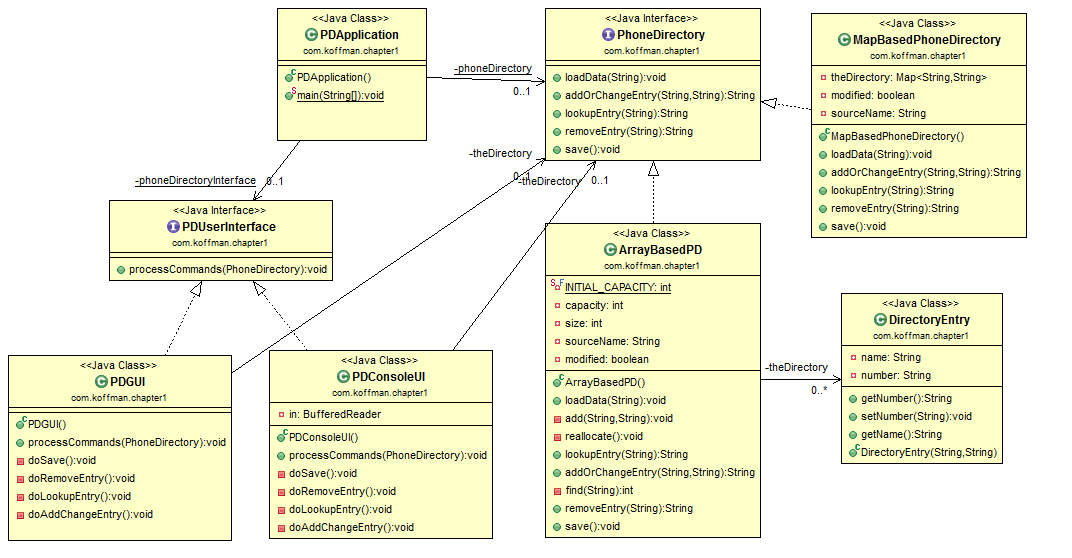
import java.io.BufferedReader;
import java.io.FileNotFoundException;
import java.io.FileReader;
import java.io.FileWriter;
import java.io.IOException;
import java.io.PrintWriter;
import java.util.HashMap;
import java.util.Iterator;
import java.util.Map;

public class MapBasedPhoneDirectory implements PhoneDirectory {
	// Data fields

	/** The directory data */
	private Map<String, String> theDirectory = new HashMap<String, String>();

	private boolean modified = false;

	/** The name of the data file */
	private String sourceName = null;

	@Override
	public void loadData(String sourceName) {
		// Remember the source name
		this.sourceName = sourceName;

		try {
			// Create a BufferedReader for the file.
			BufferedReader in = new BufferedReader(new FileReader(sourceName));
			String name;
			String number;

			// Read each name and number and add the entry to the array
			while ((name = in.readLine()) != null) {
				// Read name and number from successive lines.
				if ((number = in.readLine()) == null) {
					break; // No number - end of data reached.
				}

				// Add an entry for this name and number.
				theDirectory.put(name, number);
			}
			in.close();
		} catch (FileNotFoundException fnfe) {
			return;
		} catch (IOException ioe) {
			System.err.println("Load of directory failed.");
			ioe.printStackTrace();
			System.exit(1);
		}
	}

	@Override
	public String addOrChangeEntry(String name, String number) {
		String oldNumber = theDirectory.put(name, number);
		modified = true;

		return oldNumber;
	}

	@Override
	public String lookupEntry(String name) {
		return theDirectory.get(name);
	}

	@Override
	public String removeEntry(String name) {
		String returnValue = theDirectory.remove(name);
		if (returnValue != null) {
			modified = true; // set to true only if the item is found and
								// removed.
		}
		return returnValue;
	}

	@Override
	public void save() {
		if (modified) { // if not modified, do nothing.
			try {
				PrintWriter out = new PrintWriter(new FileWriter(sourceName));
				Iterator<Map.Entry<String, String>> iter = theDirectory
						.entrySet().iterator();
				while (iter.hasNext()) {
					Map.Entry<String, String> current = (Map.Entry<String, String>) iter
							.next();
					out.println(current.getKey());
					out.println(current.getValue());
				}
				// Close the file.
				out.close();
				modified = false;
			} catch (Exception e) {
				System.err.println("Save of directory failed.");
				e.printStackTrace();
				System.exit(1);
			}
		}
	}

}


/** The interface for the telephone directory */
public interface PhoneDirectory {

	/**
	 * Load the data file containing the directory, or establish a connection
	 * with the data source
	 * @param sourceName The name of the file (data source) with the phone directory entries
	 */
	void loadData(String sourceName);

	/** Add an entry or change an existing entry.
	 *
	 * @param name The name of the person being added or changed
	 * @param number The new number to be assigned
	 * @return The old number, or if a new entry, null
	 */
	String addOrChangeEntry(String name, String number);

	/**
	 *
	 * @param name The name of the person to lookup
	 * @return The number or null if name is not in the directory
	 */
	String lookupEntry(String name);

	/**
	 * Remove an entry from the directory
	 * @param name The name of the person to be removed
	 * @return The current number.If not in the directory, null is returned
	 */
	String removeEntry(String name);

	/**
	 * Method to save the directory
	 * pre: The directory has been loaded with data
	 * post: Contents of the directory written back to the file in the form of name-number pairs on
	 * adjacent lines
	 * modified is reset to false.
	 */
	void save();

}

/**
 * Program to display and modify a simple phone directory
 *
 */
public class PDApplication {
	private static PhoneDirectory phoneDirectory;
	private static PDUserInterface phoneDirectoryInterface;

	public static void main(String[] args) {
		// Check to see if there is a command line argument.
		if (args.length == 0) {
			System.err.println("You must provide the name of the file that contains the phone directory.");
			System.exit(1);
		}

		// Create a phone directory object.
		phoneDirectory = new MapBasedPhoneDirectory();

		// Load the phone directory from the file.
		phoneDirectory.loadData(args[0]);

		// Create a phone directory user interface.
		phoneDirectoryInterface = new PDConsoleUI(); // PDGUI();

		phoneDirectoryInterface.processCommands(phoneDirectory);
	}
}
/**
 * Hash table implementation that uses open addressing where
 * each hash table element of type Object references a single <Key,Value> pair.
 *
 */


public interface IHashMap {
	/**
	 * Returns the value associated with the specified key. Returns null if the key is not present.
	 * @param key
	 * @return
	 */
	Object get(Object key);

	/**
	 * Returns true if this table contains no key-value mappings.
	 * @return
	 */
	boolean isEmpty();

	/**
	 * Associates the specified value with the specified key.
	 * Returns the previous value associated with the specified key,
	 * or null if there was no mapping for the key.
	 * @param key
	 * @param value
	 * @return
	 */
	Object put(Object key, Object value);

	/**
	 * Removes the mapping for this key from this table if it is present.
	 * Returns the previous value associated with the specified key, or null
	 * if there was no mapping.
	 * @param key
	 * @return
	 */
	Object remove(Object key);

	/**
	 * Returns the size of the table.
	 * @return
	 */
	int size();
}

public class HashTableOpen implements IHashMap {
	// inner class.
	private static class Entry {
		/** The key */
		private Object key;

		/** The value */
		private Object value;

		/**
		 * Creates a new key-value pair.
		 *
		 * @param key
		 * @param value
		 */
		public Entry(Object key, Object value) {
			this.key = key;
			this.value = value;
		}

		public Object getKey() {
			return key;
		}

		public Object getValue() {
			return value;
		}

		public Object setValue(Object value) {
			Object oldValue = this.value;
			this.value = value;

			return oldValue;
		}

		@Override
		public String toString() {
			return "<" + getKey() + ", " + getValue() + ">";
		}
	}

	// Data fields
	/** The hash table array */
	private Entry[] table;

	/** The initial capacity */
	private static final int START_CAPACITY = 101;

	/** The max. load factor */
	private double LOAD_THRESHOLD = 0.75;

	/** The number of keys in the table excluding the keys that were deleted */
	private int numKeys;

	/** The number of deleted keys */
	private int numDeletes;

	/** A special object to indicate that an entry has been deleted. */
	private static final Entry DELETED = new Entry("*****", "*****");

	// Constructor
	public HashTableOpen() {
		table = new Entry[START_CAPACITY];
	}

	/**
	 * Method get for class HashTableOpen
	 *
	 * @param key
	 *            The key being sought
	 * @return The value associated with this key if found; otherwise null.
	 */
	@Override
	public Object get(Object key) {
		// Find the first table element that is empty or the the table element
		// that contains the key.
		int index = find(key);

		// if the search is successful, return the value.
		if (table[index] != null) {
			return table[index];
		} else {
			return null; // key not found.
		}
	}

	@Override
	public boolean isEmpty() {
		return numKeys == 0;
	}

	/**
	 * Method put for class HashTableOpen post: This key-value pair is inserted
	 * in the table and numKeys is incremented. If the key is already in the
	 * table, its value is changed to the argument value and numKeys is not
	 * changed. If the LOAD_THRESHOLD is exceeded, the table is expanded.
	 *
	 * @param key
	 *            The key of item being inserted
	 * @param value
	 *            The value for this key
	 * @return Old value associated with this key if found; otherwise null.
	 */
	@Override
	public Object put(Object key, Object value) {
		// Find the first table element that is empty
		// or the table that contains the key.
		int index = find(key);

		// If an empty element was found, insert new entry.
		if (table[index] == null) {
			table[index] = new Entry(key, value);
			numKeys++;

			// Check whether rehash is needed
			double loadFactor = (double) (numKeys + numDeletes) / table.length;
			if (loadFactor > LOAD_THRESHOLD) {
				rehash();
			}
		}

		// assert: table element that contains the key was found.
		// Replace value for this key.
		Object oldVal = table[index].value;
		table[index].value = value;
		return oldVal;
	}

	/**
	 * Expands table size when load factor exceeds LOAD_THRESHOLD post: The size
	 * of the table is doubled and is an odd integer. Each nondeleted entry from
	 * the original table is reinserted into the expanded table. The value of
	 * numKeys is reset to the number of items actually inserted; numDeletes is
	 * reset to 0.
	 */
	private void rehash() {
		// Save a reference to oldTable.
		Entry[] oldTable = table;

		// Double capacity of this table.
		table = new Entry[1 * oldTable.length + 1];

		// Reinsert all items in oldTable into expanded table.
		numKeys = 0;
		numDeletes = 0;
		for (int i = 0; i < oldTable.length; i++) {
			if ((oldTable[i] != null) && (oldTable[i] != DELETED)) {
				// insert entry in expanded table
				put(oldTable[i].key, oldTable[i].value);
				numKeys++;
			}
		}
	}

	/**
	 * Remove a table element by setting it to reference object DELETED.
	 *
	 * @param key
	 *            The key of item being deleted.
	 * @return The previous value associated with the specified key, or null if
	 *         there was no mapping for the key.
	 */
	@Override
	public Object remove(Object key) {
		// Find the first table element that is empty
		// or the table that contains the key.
		int index = find(key);

		// If an empty element was found return null
		if (table[index] == null) {
			return null;
		} else {
			// key was found
			table[index] = DELETED;
			numDeletes++;
			numKeys--;

			return table[index].value;
		}
	}

	@Override
	public int size() {
		return numKeys;
	}

	/**
	 * Finds either the target key or the first empty slot in the search chain
	 * using linear probing. pre: The table is not full
	 *
	 * @param key
	 *            The key of the target object
	 * @return The position of the target or the first empty slot if the target
	 *         is not in the table.
	 */
	private int find(Object key) {
		// Calculate the starting index.
		int index = key.hashCode() % table.length;
		if (index < 0) {
			index += table.length; // Make it positive
		}

		// increment index until an empty slot is reached or the key is found.
		while ((table[index] != null) && (!table[index].key.equals(key))) {
			index++;

			// Check for wrap around
			if (index >= table.length) {
				index = 0; // Wrap around
			}
		}

		return index;
	}

	public static void main(String[] args) {
		HashTableOpen hashTable = new HashTableOpen();
		hashTable.put("34", "İstanbul");
		hashTable.put("44", "Malatya");
		hashTable.put("77", "Yalova");

		System.out.println("Value for key 44 is: " + hashTable.get("44"));
		System.out.println("Key 06 is" + (hashTable.get("06") == null ? " not" : "") + " found in hash table...");
		System.out.println("Key 34 is" + (hashTable.get("34") == null ? " not" : "") + " found in hash table...");

		for (int i = 0; i < HashTableOpen.START_CAPACITY; i++) {
			System.out.println(hashTable.table[i]);
		}
	}
}
In this blog we implement the index by storing each word and all the line numbers for that word as a single index entry.
import java.io.BufferedReader;
import java.io.FileReader;
import java.io.IOException;
import java.text.Collator;
import java.util.ArrayList;
import java.util.Iterator;
import java.util.Locale;
import java.util.Map.Entry;
import java.util.StringTokenizer;
import java.util.TreeMap;

/**
 * Building an Index/Glossary for a book using Map
 *
 */
public class IndexGenerator {
	// Data fields

	/** Gets the collator for the default locale */
	private final Collator collator = Collator.getInstance(Locale.getDefault());

	/** The search tree used to store the index. */
	private TreeMap<String, ArrayList<Integer>> index = new TreeMap<String, ArrayList<Integer>>(
			collator);

	public void buildIndexAllLines(BufferedReader br) throws IOException {
		int lineNum = 0; // Line number
		String nextLine; // Each data line

		// Keep reading lines until done.
		while ((nextLine = br.readLine()) != null) {
			lineNum++;

			// Create a StringTokenizer for the current data line
			// using punctuation and white space as delimiters.
			StringTokenizer tokens = new StringTokenizer(nextLine,
					" ,.:-!?/%()\"“”");

			// insert each token in the index.
			while (tokens.hasMoreTokens()) {
				String word = tokens.nextToken().toLowerCase();
				ArrayList<Integer> lines = (ArrayList<Integer>) index.get(word);

				// Get the list
				if (lines == null) {
					lines = new ArrayList<Integer>();
				}
				if (!lines.contains(lineNum)) {
					lines.add(new Integer(lineNum));
				}

				index.put(word, lines); // Store new list.
			}
		}
	}

	public static void main(String[] args) throws IOException {
		IndexGenerator app = new IndexGenerator();
		BufferedReader br = new BufferedReader(new FileReader(args[0]));
		app.buildIndexAllLines(br);
		showIndex(app);
	}

	private static void showIndex(IndexGenerator app) {
		Iterator<Entry<String, ArrayList<Integer>>> indexIter = app.index
				.entrySet().iterator();
		while (indexIter.hasNext()) {
			Entry<String, ArrayList<Integer>> entry = indexIter.next();

			StringBuffer buff = new StringBuffer(entry.getKey());
			Iterator<Integer> valueIter = entry.getValue().iterator();
			while (valueIter.hasNext()) {
				Integer integer = (Integer) valueIter.next();
				buff.append(", ").append(integer);
			}
			System.out.println(buff.toString());
		}
	}
}

The sample output is what follows:
bahçesinde, 13
bahçesindeki, 15
bakımından, 21
balyan’a, 5
barındığı, 13
barındırmak, 25
başkalarının, 5
batı, 7, 15, 21
bazılarıdır, 5
belirlenen, 17
benzer, 21
benzerlikler, 7
beylerbeyi, 1, 3, 5, 11, 15, 17, 19, 25, 29
biçimde, 27
biçiminde, 11
bir, 1, 3, 7, 9, 15, 17, 19, 23, 25, 29
biri, 1, 19, 25
import java.io.PrintStream;
import java.io.Serializable;
import java.util.Comparator;
import java.util.PriorityQueue;
import java.util.Queue;

/**
 * Class to represent and build a Huffman tree.
 *
 */
@SuppressWarnings("serial")
public class HuffmanTree implements Serializable {
	// Nested classes
	/** A datum in the Huffman tree */
	public static class HuffData implements Serializable {
		// Data fields

		/** The weight or probability assigned to this HuffData */
		private double weight;

		/** The alphabet symbol if this is a leaf */
		private Character symbol;

		public HuffData(double weight, Character symbol) {
			this.weight = weight;
			this.symbol = symbol;
		}

		public Character getSymbol() {
			return symbol;
		}
	}

	// Data fields

	/** A reference to the completed Huffman tree */
	private BinaryTree<HuffData> huffTree;

	/**
	 * A Comparator for Huffman trees; nested class
	 */
	private static class CompareHuffmanTrees implements
			Comparator<BinaryTree<HuffData>> {
		/**
		 * Compare two objects.
		 *
		 * @param
		 */
		@Override
		public int compare(BinaryTree<HuffData> treeLeft,
				BinaryTree<HuffData> treeRight) {
			double wLeft = treeLeft.getData().weight;
			double wRight = treeRight.getData().weight;

			return Double.compare(wLeft, wRight);
		}
	}

	/**
	 * Builds the Huffman tree using the given alphabet and weights. post:
	 * huffTree contains a reference to the Huffman tree.
	 *
	 * @param symbols
	 *            An array of HuffData objects
	 */
	public void buildTree(HuffData[] symbols) {
		Queue<BinaryTree<HuffData>> theQueue = new PriorityQueue<BinaryTree<HuffData>>(
				symbols.length, new CompareHuffmanTrees());

		// Load the queue with the leaves.
		// The loop loads the priority queue with trees consisting of just leaf
		// nodes.
		// Each leaf node contains a HuffData object with the weight and
		// alphabet symbol.

		for (HuffData nextSymbol : symbols) {
			BinaryTree<HuffData> binaryTree = new BinaryTree<HuffData>(nextSymbol, null, null);
			theQueue.offer(binaryTree);
		}

		// Build the tree from the bottom up. The first step is to remove the
		// first two tree references from the priority
		// queue and combine them to form a new tree. We insert the new tree
		// back into the priority queue.
		// Again we remove the first two references and combine them.
		// We repeat the process until there is one tree in the queue, and
		// that will be the Huffman tree.

		while (theQueue.size() > 1) { // While the priority queue has more
											// than one item
			BinaryTree<HuffData> left = theQueue.poll();
			BinaryTree<HuffData> right = theQueue.poll();
			double wl = left.getData().weight;
			double wr = right.getData().weight;
			HuffData sum = new HuffData(wl + wr, null);

			BinaryTree<HuffData> newTree = new BinaryTree<HuffData>(sum, left, right);
			theQueue.offer(newTree);
		}

		// The queue should now contain only one item.
		huffTree = theQueue.poll();
	}

	public static void main(String[] args) {
		HuffData[] symbols = { new HuffData(22, 'c'), new HuffData(13, 'b'),
				new HuffData(32, 'd'), new HuffData(64, 'a'),
				new HuffData(103, 'e'), };
		HuffmanTree huffmanTree = new HuffmanTree();
		huffmanTree.buildTree(symbols);
		huffmanTree.printCode(System.out);

		System.out.println("\n'1110' decoded to: " + huffmanTree.decode("1110"));
	}

	/**
	 * Outputs the resulting code.
	 * To display the code for each alphabet symbol, we perform a preorder traversal of the finl tree.
	 * When we traverse the left subtree we append a 0 to the code, and when we traverse the right
	 * subtree, we append a 1 to the code.
	 *
	 * @param out
	 *            A PrintStream to write the output to.
	 * @param code
	 *            The code up to this node.
	 * @param tree
	 *            The current node in the tree
	 */
	private void printCode(PrintStream out, String code, BinaryTree<HuffData> tree) {
		HuffData theData = tree.getData();
		if (theData.symbol != null) {
			if (theData.symbol.equals(' ')) {
				out.println("space: " + code);
			} else {
				out.println(theData.symbol + ": " + code);
			}
		} else {
			printCode(out, code + "0", tree.getLeftSubTree());
			printCode(out, code + "1", tree.getRigthSubTree());
		}
	}

	/**
	 * Outputs the resulting code.
	 *
	 * @param out
	 *            A PrintStream to write the output to
	 */
	public void printCode(PrintStream out) {
		printCode(out, "", huffTree);
	}

	/**
	 * Method to decode a message that is input as a string of digit characters '0' and '1'
	 * @param codedMessage
	 * @return The decoded message as a String.
	 */
	public String decode(String codedMessage) {
		StringBuffer result = new StringBuffer();
		BinaryTree<HuffData> currentTree = huffTree;

		for (int i = 0; i < codedMessage.length(); i++) {
			if (codedMessage.charAt(i) == '1') {
				currentTree = currentTree.getRigthSubTree();
			} else {
				currentTree = currentTree.getLeftSubTree();
			}

			if (currentTree.isLeaf()) {
				HuffData theData = currentTree.getData();
				result.append(theData.symbol);
				currentTree = huffTree;
			}
		}

		return result.toString();
	}
}
The out is
e: 0
a: 10
d: 110
b: 1110
c: 1111

'1110' decoded to: b
/**
 * interface that defines a priority queue. A priority queue is similar to a queue, except that
 * items are removed in priority order, where the smallest value is considered the highest priority.
 * The PriorityQueue interface is effectively the same as the Queue interface. The differences
 * are in the specification for the peek and remove methods. These are defined to return
 * the smallest item in the queue rather than the oldest item in the queue.
 *
 * The smallest item is always removed first from a priority queue(the smallest item has the highest priority)
 * just as it is for a heap.
 *
 * Note that classes that implement the PriorityQueue interface are free to require that the objects
 * that are inserted implement Comparable by documenting that an exception will be thrown if they don't.
 *
 */
public interface PriorityQueue {

	/**
	 * insert an item into the queue based on its priority.
	 * post: The item is inserted into the priority queue.
	 * @param item The item to be inserted.
	 */
	void insert(Object item);

	/**
	 * Peek at the smallest item in the queue.
	 * post: The priority queue remains unchanged.
	 * @return The item with the smallest priority value.
	 * @throws EmptyQueueException if the queue is empty.
	 */
	Object peek();


	/**
	 * Remove the smallest item in the queue.
	 * post: The item is no longer in the queue.
	 * @return The item with the smallest priority value.
	 * @throws EmptyQueueException if the queue is empty.
	 */
	Object remove();

	/**
	 * Return the size of the queue.
	 * @return The number of items in the queue.
	 */
	int getSize();

	/**
	 * Determine whether the queue is empty.
	 * @return true if the queue is empty.
	 */
	boolean isEmpty();
}


import java.util.ArrayList;

/**
 * The HeapPriorityQueue implements PriorityQueue interface by building a heap
 * in an ArrayList. The heap is structured so that the 'smallest' item is at the
 * top.
 *
 */
public class HeapPriorityQueue implements PriorityQueue {
	// Data fields

	/** The ArrayList to hold the data */
	private ArrayList<Object> theData = new ArrayList<Object>();

	// Methods
	/**
	 * Compare two items using their natural ordering. pre: Both left and right
	 * implement Comparable.
	 *
	 * @param left
	 *            One item
	 * @param right
	 *            The other item
	 * @return Negative integer if left less than right, 0 if left equals right,
	 *         positive integer if left > right
	 * @throws ClassCastException
	 *             if items are not Comparable.
	 */
	@SuppressWarnings({ "unchecked" })
	protected int compare(Object left, Object right) {
		Comparable<Object> comparable = (Comparable<Object>) left;
		return comparable.compareTo(right);
	}

	protected void swap(int parent, int child) {
		Object temp = theData.get(parent);
		theData.set(parent, theData.get(child));
		theData.set(child, temp);
	}

	/**
	 * Insert an item into the priority queue. pre: The item to be inserted
	 * implements Comparable and the ArrayList theData is in heap order. post:
	 * The item is in the priority queue and theData is in heap order.
	 */
	@Override
	public void insert(Object item) {
		// Add the item to the heap.
		theData.add(item);

		// Child is newly inserted item.
		int child = theData.size() - 1;
		int parent = (child - 1) / 2; // Find child's parent.

		// Reheap
		while (parent >= 0
				&& compare(theData.get(parent), theData.get(child)) > 0) {
			swap(parent, child);
			child = parent;
			parent = (child - 1) / 2;
		}
	}

	/**
	 * Peeks at the smallest item in the queue.
	 */
	@Override
	public Object peek() {
		if (isEmpty()) {
			throw new EmptyQueueException();
		} else {
			return theData.get(0);
		}
	}

	/**
	 * Remove an item from the priority queue. pre: The ArrayList theData is in
	 * heap order post: The ArrayList theData is in heap order
	 *
	 * @return The item with the smallest priority value.
	 * @throws EmptyQueueException
	 *             if the queue is empty.
	 */
	@Override
	public Object remove() {
		if (isEmpty()) {
			throw new EmptyQueueException();
		}

		// Save the top of the heap.
		Object result = theData.get(0);

		// If only one item then remove it.
		if (theData.size() == 1) {
			theData.remove(0);
			return result;
		}

		// Remove the last item from the ArrayList and place it into the first
		// position.
		theData.set(0, theData.remove(theData.size() - 1));

		// The parent starts at the top.
		int parent = 0;
		while (true) {
			int leftChild = 2 * parent + 1;
			if (leftChild >= theData.size()) {
				// The item has moved down the tree so that it has no children.
				break;
			}
			int rightChild = leftChild + 1; // 2 * p + 2
			int minChild = leftChild; // Assume left child is smaller.

			// See whether right child is smaller
			if (rightChild < theData.size()
					&& compare(theData.get(leftChild), theData.get(rightChild)) > 0) {
				minChild = rightChild;
			}
			// assert: minChild is the index of the smaller child.
			// Move smaller child up heap if necessary.
			if (compare(theData.get(parent), theData.get(minChild)) > 0) {
				swap(parent, minChild);
				parent = minChild;
			} else { // Heap property is restored.
				break;
			}
		}

		return result;
	}

	@Override
	public int getSize() {
		return theData.size();
	}

	@Override
	public boolean isEmpty() {
		return theData.size() == 0;
	}

	public static void main(String[] args) {
		HeapPriorityQueue app = new HeapPriorityQueue();

		app.theData.add(6);
		app.theData.add(18);
		app.theData.add(29);
		app.theData.add(20);
		app.theData.add(28);
		app.theData.add(39);
		app.theData.add(66);
		app.theData.add(37);
		app.theData.add(26);
		app.theData.add(76);
		app.theData.add(32);
		app.theData.add(74);
		app.theData.add(89);

		showHeap(app);
		app.insert(8);
		showHeap(app);
		app.remove();
		showHeap(app);
	}

	private static void showHeap(HeapPriorityQueue app) {
		for (int i = 0; i < app.theData.size(); i++) {
			System.out.print(app.theData.get(i) + " ");
		}
		System.out.println();
	}
}
import java.util.ArrayList;

/**
 * Class for Heap which is a complete binary tree.
 *
 */
public class Heap {
	// Data field.
	private ArrayList<Integer> heap;

	public Heap() {
		heap = new ArrayList<Integer>();
		init();
	}

	/**
	 * insert the new value into the lower right position. Then move the
	 * inserted value up the heap, by comparing to the values stored in its
	 * ancestor nodes. The parent is in position (c-1) / 2. Note that for a node
	 * at position p, the left child is at 2p+1, and the right child is at
	 * position 2p+2.
	 *
	 * @param elem
	 */
	public void insert(Integer elem) {
		heap.add(elem);

		int child = heap.size() - 1;
		int parent = (child - 1) / 2;

		while (parent >= 0 && heap.get(parent) > heap.get(child)) {
			int parentElem = heap.get(parent);
			heap.set(parent, heap.get(child));
			heap.set(child, parentElem);

			child = parent;
			parent = (child - 1) / 2;
		}
	}

	/**
	 * In removing elements from a heap, we must always remove and save the
	 * element at top of the heap, which is the smallest element.
	 */
	public void remove() {
		int lastItemInHeap = heap.get(heap.size() - 1);
		heap.set(0, lastItemInHeap);
		heap.remove(heap.size() - 1);
		int parent = 0;

		while (true) {
			int leftChild = 2 * parent + 1;
			int rightChild = leftChild + 1; // 2 * p + 2
			int minChild = leftChild;

			if (leftChild >= heap.size()) {
				// The item has moved down the tree so that it has no children.
				break;
			}

			// Assume the smallest child is leftChild.
			if (rightChild < heap.size()
					&& heap.get(rightChild) < heap.get(leftChild)) {
				minChild = rightChild;
			}

			if (heap.get(parent) > heap.get(minChild)) {
				// Swap
				int temp = heap.get(parent);
				heap.set(parent, heap.get(minChild));
				heap.set(minChild, temp);

				parent = minChild;
			} else {
				// It's smaller than both its children.
				break;
			}
		}
	}

	public static void main(String[] args) {
		Heap app = new Heap();
		app.showHeap();

		app.insert(8);
		app.showHeap();

		app.remove();
		app.showHeap();
	}

	private void showHeap() {
		for (Integer integer : heap) {
			System.out.print(integer + " ");
		}
		System.out.println();
	}

	// Construct the array list.
	private void init() {
		heap.add(6);
		heap.add(18);
		heap.add(29);
		heap.add(20);
		heap.add(28);
		heap.add(39);
		heap.add(66);
		heap.add(37);
		heap.add(26);
		heap.add(76);
		heap.add(32);
		heap.add(74);
		heap.add(89);
	}

}

The output is:
6 18 29 20 28 39 66 37 26 76 32 74 89
6 18 8 20 28 39 29 37 26 76 32 74 89 66
8 18 29 20 28 39 66 37 26 76 32 74 89
import java.io.BufferedReader;
import java.io.FileReader;
import java.io.IOException;
import java.text.Collator;
import java.text.DecimalFormat;
import java.util.Iterator;
import java.util.Locale;
import java.util.StringTokenizer;
import java.util.TreeSet;

/**
 * Class to build an index/glossary.
 */
public class IndexGenerator {
	// Data fields

	/** Gets the collator for the default locale */
	private final Collator collator = Collator.getInstance(Locale.getDefault());

	/** The search tree used to store the index. */
	private TreeSet<String> index = new TreeSet%lt;String>(collator);

	/** String for formatting numbers as 4 digits with leading zeros. */
	private static final String LEADING_ZEROS = "0000";

	// Methods

	/**
	 * Reads each word from the file referenced by Buffered Reader and stores it
	 * in the tree index. post:Lowercase form of each word with line number
	 * stored in the index.
	 *
	 * @param br
	 *            A reference to the data file.
	 * @throws IOException
	 */
	public void buildIndex(BufferedReader br) throws IOException {
		DecimalFormat threeDigits = new DecimalFormat(LEADING_ZEROS);
		int lineNum = 0;
		String nextLine;

		// Keep reading lines until done.
		while ((nextLine = br.readLine()) != null) {
			lineNum++;

			StringTokenizer tokens = new StringTokenizer(nextLine,
					" ,.:-!?/%()\"“”");
			while (tokens.hasMoreTokens()) {
				String nextToken = tokens.nextToken().toLowerCase();
				index.add(nextToken + ", " + threeDigits.format(lineNum));
			}
		}
	}

	/**
	 * Performs an inorder traversal of tree index, one word per line
	 */
	public void showIndex() {
		Iterator<String> indexIter = index.iterator();
		// Use iterator indexIter to access and display tree data
		String prevToken = "";
		while (indexIter.hasNext()) {
			StringBuffer sb = new StringBuffer();
			String currToken = indexIter.next();
			String[] parts = currToken.split(", ");

			if (!parts[0].equals(prevToken)) {
				System.out.println();
				for (int i = 0; i < parts.length; i++) {
					sb.append(parts[i]).append(", ");
				}
				prevToken = parts[0];
			} else {
				for (int i = 1; i < parts.length; i++) {
					sb.append(parts[i]).append(", ");
				}
			}

			System.out.print(sb.toString());
		}
	}

	public static void main(String[] args) throws IOException {
		IndexGenerator app = new IndexGenerator();
		BufferedReader br = new BufferedReader(new FileReader(args[0]));
		app.buildIndex(br);
		app.showIndex();
	}
}

Glossary generated for a book titled Beylerbeyi Palace:
barındırmak, 0025,
başkalarının, 0005,
batı, 0007, 0015, 0021,
bazılarıdır, 0005,
belirlenen, 0017,
benzer, 0021,
benzerlikler, 0007,
beylerbeyi, 0001, 0003, 0005, 0011, 0015, 0017, 0019, 0025, 0029,
biçimde, 0027,
biçiminde, 0011,
bir, 0001, 0003, 0007, 0009, 0015, 0017, 0019, 0023, 0025, 0029,
biri, 0001, 0019, 0025,
birini, 0011,

import javax.swing.JOptionPane;

/**
 * Class that solves Towers of Hanoi problem.
 */
public class TowersOfHanoi {
	public static String showMoves(int n, char startPeg, char destPeg,
			char tempPeg) {
		if (n == 1) {
			return "Move disk 1 from peg " + startPeg + " to peg " + destPeg
					+ "\n";
		} else {
			return showMoves(n - 1, startPeg, tempPeg, destPeg) + "Move disk "
					+ n + " from peg " + startPeg + " to peg " + destPeg + "\n"
					+ showMoves(n - 1, tempPeg, destPeg, startPeg);
		}
	}

	public static void main(String[] args) {
		String nDisks = JOptionPane.showInputDialog("Enter number of disks");
		String startPeg = JOptionPane
				.showInputDialog("Enter start peg (L, M, R)");
		String destPeg = JOptionPane
				.showInputDialog("Enter destination peg (L, M, R), but not "
						+ startPeg);
		String tempPeg = JOptionPane
				.showInputDialog("Enter temporary peg (L, M, R), but not "
						+ startPeg + " or " + destPeg);

		String moves = showMoves(Integer.parseInt(nDisks), startPeg
				.toUpperCase().charAt(0), destPeg.toUpperCase().charAt(0),
				tempPeg.toUpperCase().charAt(0));
		JOptionPane.showMessageDialog(null, moves);
	}
}
public static int binarySearch(Object[] items, Comparable<Object> target,
			int first, int last) {
		if (first > last) {
			return -1;
		} else {
			int middle = (first + last) / 2;
			int compResult = target.compareTo(items[middle]);
			if (compResult == 0) {
				return middle; // Base case for successful search
			} else if (compResult < 0) {
				return binarySearch(items, target, first, middle - 1);
			} else { // > 0
				return binarySearch(items, target, middle + 1, last);
			}
		}
	}
import java.util.EmptyStackException;
import java.util.Stack;
import java.util.StringTokenizer;

import javax.swing.JOptionPane;

/** Translates an infix expression to a postfix expression. */

public class InfixToPostfix {
	// Nested class to report a syntax error.
	@SuppressWarnings("serial")
	public static class SyntaxErrorException extends Exception {
		public SyntaxErrorException(String message) {
			super(message);
		}
	}

	// Constant
	/** A list of operators */
	private static final String OPERATORS = "+-*/()";

	// The precedence of the operators, matches order in OPERATORS.
	private static final int[] PRECEDENCE = { 1, 1, 2, 2, -1, -1 };

	// Data fields
	/** Stack of operators */
	private Stack<Character> operatorStack;

	/** The postfix string being formed */
	private StringBuffer postfix;

	// Methods
	/**
	 * Extracts and processes each token in infix and returns the equivalent
	 * postfix.
	 *
	 * @param infix
	 *            The infix expression.
	 * @return The equivalent postfix.
	 * @throws SyntaxErrorException
	 */
	public String convert(String infix) throws SyntaxErrorException {
		postfix = new StringBuffer();
		operatorStack = new Stack<Character>();

		// Process each token.
		StringTokenizer infixTokens = new StringTokenizer(infix);
		try {
			while (infixTokens.hasMoreTokens()) {
				String nextToken = infixTokens.nextToken();
				char ch = nextToken.charAt(0);

				// Is it an operand?
				if (Character.isJavaIdentifierStart(ch)
						|| Character.isDigit(ch)) {
					postfix.append(ch);
					postfix.append(' ');
				} else if (isOperator(ch)) {
					processOperator(ch);
				} else {
					throw new SyntaxErrorException(
							"Unexpected char encountered: " + ch);
				}
			}
			// Pop any remaining operators and append them to the postfix.
			while (!operatorStack.empty()) {
				char ch = operatorStack.pop();
				// Any '(' on the stack is not matched.

				if (ch == '(') {
					throw new SyntaxErrorException("Unmatched opening parentheses");
				}
				postfix.append(ch);
				postfix.append(' ');
			}

			// assert: Stack is empty, return result.
			return postfix.toString();
		} catch (EmptyStackException e) {
			// Pop was attempted on an empty stack.
			throw new SyntaxErrorException("Syntax error: The stack is empty");
		}
	}

	public static void main(String[] args) {
		InfixToPostfix app = new InfixToPostfix();
		String infix = JOptionPane.showInputDialog("Enter an infix expression");
		try {
			PostfixEvaluator postfixApp = new PostfixEvaluator();
			String postfixForm = app.convert(infix);
			JOptionPane.showMessageDialog(null, "Infix expression " + infix
					+ "\nconverts to " + postfixForm);
			JOptionPane.showMessageDialog(null, "The postfix value is = "
					+ postfixApp.eval(postfixForm));
		} catch (Exception e) {
			JOptionPane.showMessageDialog(null, e.getMessage());
		}
		System.exit(0);
	}

	/**
	 * Processes operator op by updating operatorStack
	 *
	 * @param op
	 *            The operator
	 * @throws EmptyStackException
	 */
	private void processOperator(char op) {
		if (operatorStack.empty() || op == '(') {
			operatorStack.push(op);
		} else {
			// Peek the operator stack and let topOp be top operator.
			char topOp = operatorStack.peek();
			if (precedence(op) > precedence(topOp)) {
				operatorStack.push(op);
			} else {
				// Pop all stacked operators with equal or higher precedence
				// than op.
				while (!operatorStack.empty()
						&& precedence(op) <= precedence(topOp)) {
					operatorStack.pop();

					if (topOp == '(') {
						// Matching '(' popped - exit loop
						break;
					}
					postfix.append(topOp);
					postfix.append(' ');

					if (!operatorStack.empty()) {
						// Reset topOp.
						topOp = operatorStack.peek();
					}
				}

				// assert: Operator stack is empty or current operator
				// precedence > top of stack operator precedence.
				// The closing parenthesis is considered processed when an opening parentheses is popped from the stack

				if (op != ')') {
					operatorStack.push(op);
				}
			}
		}
	}

	/**
	 *
	 * @param ch
	 * @return The precedence of operator op.
	 */
	private int precedence(char op) {
		return PRECEDENCE[OPERATORS.indexOf(op)];
	}

	/**
	 *
	 * @param ch
	 * @return true if ch is an operator
	 */
	private boolean isOperator(char ch) {
		return OPERATORS.indexOf(ch) != -1;
	}
}
import java.util.EmptyStackException;
import java.util.Stack;
import java.util.StringTokenizer;

public class PostfixEvaluator {
	// Nested class to report a syntax error.
	@SuppressWarnings("serial")
	public static class SyntaxErrorException extends Exception {
		public SyntaxErrorException(String message) {
			super(message);
		}
	}

	// Constant
	/** A list of operators */
	private static final String OPERATORS = "+-*/";

	// Data fields
	/** The operand stack */
	Stack<Integer> operandStack;

	// Methods
	/**
	 * Evaluates a postfix expression.
	 *
	 * @param expression
	 *            The expression to be evaluated.
	 * @return The value of the expression.
	 * @throws SyntaxErrorException
	 *             if a syntax error is detected.
	 */
	public int eval(String expression) throws SyntaxErrorException {
		// Create an empty stack.
		operandStack = new Stack<Integer>();

		// Process each token.
		StringTokenizer tokens = new StringTokenizer(expression);
		try {
			while (tokens.hasMoreElements()) {
				String nextToken = tokens.nextToken();
				char ch = nextToken.charAt(0);

				// Does it start with a digit?
				if (Character.isDigit(ch)) {
					// Get the integer value
					int value = Integer.parseInt(nextToken);

					// Push the value onto the operand stack.
					operandStack.push(value);
				} else if (isOperator(ch)) { // Is it an operator?
					// Evaluate the operator
					int result = evalOperator(ch);

					// Push the result onto the operand stack.
					operandStack.push(result);
				} else { // Invlid character
					throw new SyntaxErrorException(
							"Invalid character encountered");
				}
			}

			// No more tokens left, pop result from the operand stack.
			int answer = operandStack.pop().intValue();

			// Operand stack should be empty.
			if (operandStack.empty()) {
				return answer;
			} else {
				// Indicate syntax error.
				throw new SyntaxErrorException(
						"Syntax error: Stack should be empty");
			}
		} catch (EmptyStackException e) {
			// Pop was attempted on an empty stack.
			throw new SyntaxErrorException("Syntax error: The stack is empty");
		}
	}

	/**
	 * Evaluates the current operation This method pops the two operands off the
	 * operand stack and applies the operator.
	 *
	 * @param op
	 *            A character representing the operator.
	 * @return The result of applying the operator.
	 * @throws EmptyStackException
	 *             if pop is attempted on an empty stack.
	 */
	private int evalOperator(char op) {
		int rhs = operandStack.pop().intValue();
		int lhs = operandStack.pop().intValue();

		int result = 0;

		// Evaluate the operator
		switch (op) {
		case '+':
			result = lhs + rhs;
			break;
		case '-':
			result = lhs - rhs;
			break;
		case '*':
			result = lhs * rhs;
			break;
		case '/':
			result = lhs / rhs;
			break;
		}

		return result;
	}

	private boolean isOperator(char ch) {
		return OPERATORS.indexOf(ch) != -1;
	}

	public static void main(String[] args) throws SyntaxErrorException {
		if (0 == args.length) {
			System.err.println("Please enter the expression to evaluate...");
			System.exit(1);
		}

		String expression = args[0];
		PostfixEvaluator app = new PostfixEvaluator();

		System.out.println("The value of the expression is: "
				+ app.eval(expression));
	}
}
In this article, I'd like to provide a solution to the question using Java programming language:
For example if a linked list given to you is
Ahmet -> Ali -> Hasan -> Huseyin -> Ertugrul -> Osman
You are expected to provide the list as:
Ali -> Ahmet -> Huseyin -> Hasan -> Osman -> Ertugrul
/**
 * @author NÇ
 */
public class SwapNodes {
	public static void main(String[] args) {
		Node ahmet = new Node("Ahmet");
		Node ali = new Node("Ali");
		ahmet.next = ali;
		Node hasan = new Node("Hasan");
		ali.next = hasan;
		Node huseyin = new Node("Hüseyin");
		hasan.next = huseyin;
		Node ertugrul = new Node("Ertugrul");
		huseyin.next = ertugrul;
		Node osman = new Node("Osman");
		ertugrul.next = osman;

		traverse(ahmet);

		System.out.println("\nAfter swapping...\n");
		Node swapped = swapAdjacentPairs(ahmet);
		traverse(swapped);
	}

	/**
	 * Traverse the linked list.
	 *
	 * @param head
	 *            The linked list's head node.
	 */
	private static void traverse(Node head) {
		while (head != null) {
			System.out.print(head.data);
			if (head.next != null) {
				System.out.print(" ==> ");
			}

			head = head.next; // Advance down the list.
		}
		System.out.println();
	}

	private static Node swapAdjacentPairs(Node head) {
		if (head == null || head.next == null) {
			return head;
		}

		Node nextNode = head.next;
		Node nextPairNode = head.next.next;

		head.next.next = head;
		head.next = swapAdjacentPairs(nextPairNode);

		return nextNode;
	}

	/**
	 * A Node is the building block for a single-linked list.
	 *
	 */
	private static class Node {
		// Data fields
		/** The reference to the data */
		private Object data;

		/** The reference to the next node */
		private Node next;

		// Constructors
		/**
		 * Creates a new node with a null text field.
		 *
		 * @param dataItem
		 *            The data stored.
		 */
		private Node(Object dataItem) {
			data = dataItem;
			next = null;
		}

		/**
		 * Creates a new node that references another node.
		 *
		 * @param dataItem
		 *            The data stored
		 * @param nodeRef
		 *            The node referenced by new node
		 */
		private Node(Object dataItem, Node nodeRef) {
			data = dataItem;
			next = nodeRef;
		}
	}
}
Note that a Palindrome is a string that reads the same in left-to-right or right-to-left
For example: "step on no pets"
import java.util.Stack;

/**
 * Class with methods to check whether a string is a palindrome
 *
 * @author NÇ
 *
 */
public class Palindrome {
	/** String to store in stack */
	private String str;

	/** Stack to hold characters */
	private Stack<Character> charStack = new Stack<Character>();

	/**
	 * Store the argument string in a stack of characters.
	 *
	 * @param str
	 *            String of characters to store in the stack.
	 */
	public Palindrome(String str) {
		this.str = str;
		fillCharStack();
	}

	/**
	 * Method to fill a stack of characters from an input string
	 */
	private void fillCharStack() {
		for (int i = 0; i < str.length(); i++) {
			char nextChar = str.charAt(i);
			charStack.push(nextChar);
		}
	}

	/**
	 * post: The stack is empty.
	 *
	 * @return The string containing the words in the stack
	 */
	private String reverse() {
		StringBuffer result = new StringBuffer();
		while (!charStack.empty()) {
			result.append(charStack.pop());
		}

		return result.toString();
	}

	public boolean isPalindrome() {
		return str.equalsIgnoreCase(reverse());
	}

	public static void main(String[] args) {
		String s = args[0];
		Palindrome app = new Palindrome(s);
		boolean result = app.isPalindrome();

		System.out.println("'" + s + "'"
				+ (result == true ? " is " : " is not ") + " a palindrome");
	}
}